Super Awesome Electricity Economics Simulator
Please read the tutorial and consult the manual. This requires knowledge to use.
Tutorial: Tutorial PDF
Manual: Manual PDF
Github: https://github.com/westonpeterson1-create/Awesome-Electricity-Economics-Simulato...
This is an experimental project intended to answer questions as to how electricity sources can effect cost and CO2 emissions, and potentially why. To do this, the simulation provides a toy model of all the most common current generation sources as well as several near future technologies. Models with real world data and hourly resolution, your results will be realistic!
The unfinished tutorial .docx file can be found in the GitHub repository. Manual documentation may not be complete, for a lot of details you may need to look through the pastebin and source code.
This is just an unfinished toy model, more accurate results need to come from professionals.
Interface:
Right click: Drag Cameria
Left click: Drag slider/click button
Scroll: Zoom Camera
Red line: Demand
Green: Sum of Conventional Nuclear/Wind/Hydro/Solar production
Purple: Stored Energy (Battery + Pumped Hydro)
Dark blue: Gas turbine output
Pale Purple: Gas turbine heat recovery steam generator output.
White: Advanced Nuclear + minimum gas turbine output
Brown: Coal production
Orange: Thermal energy storage charge
Cyan: Hydrogen stored (same units as other energy storage)
I will write a tutorial for the simulation at some point. If you need help, ask on the discussion board and I will get back to you.
Rundown of scenarios:
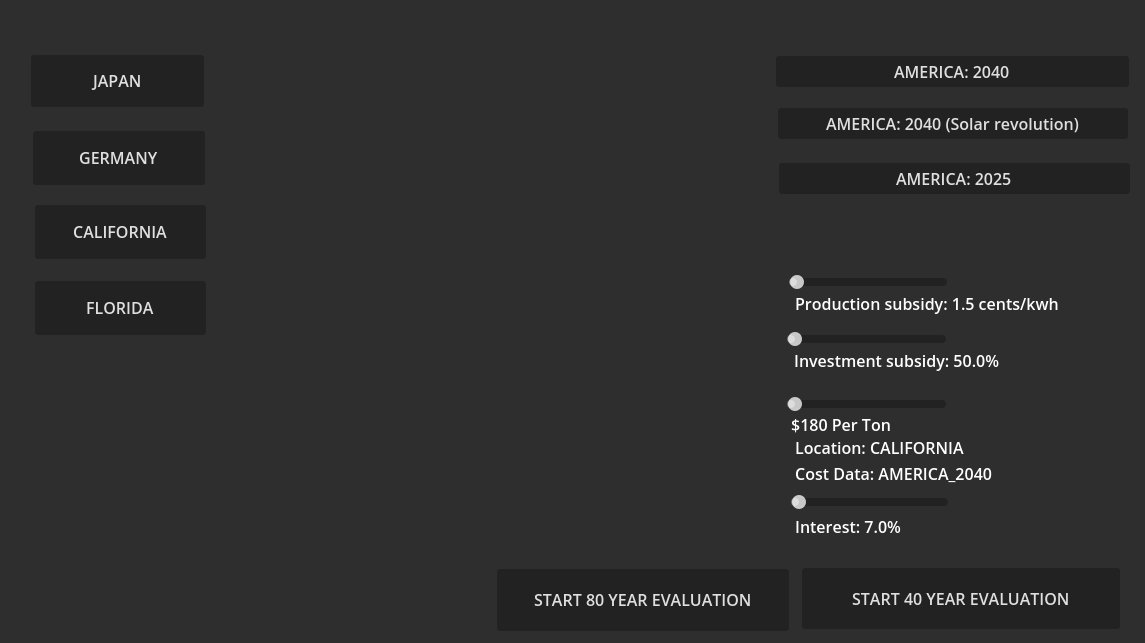
AMERICA 2025:
Costs similar to today. Nuclear cost is a little lower than Vogtle but could be achieved by some of the SMR projects. Coincidentally close to Flammanville EPR project.
AMERICA 2040:
Technology has advanced, all cleantech has gotten cheaper. Nuclear is a conservative estimate of what it may cost if it were built regularly again. Renewable predictions from NREL.GOV.
AMERICA 2040 (Solar Revolution):
Very cheap batteries and photovoltaics. Exceeds mainstream expectations, but some people are very optimistic about these and I feel it should be explored. Other technologies same as other 2040 scenario.
Cost data for all of these is from the United States, the cost of nuclear and renewables may be slightly higher than what is expected for most of the world due to trade restrictions and high labor cost.
Planned Changes:
MORE Locations/Details/Stuff :D
Ability to upload custom location/cost data
Bugfixing
Smarter dispatching for all firm power sources
Transmission/Geography (Someday I want you to be able to try out HVDC supergrids in this)
Longer term simulation
Auto-optimizer (New gamemode): Adjust policy parameters and see how it affects the "markets" choice of generation.
Partial C++ rewrite, should make sliders way snappier
Data*:
(Let me know if you think any assumptions are weird or want to see new cost scenarios)
*Ignore CO2 cost and interest rate if mentioned in the pastebin, that's a weird typo, it is only determined by sliders.
AI DISCLOSURE: AI was used to help with code to interface with Godot features. All the mathematically important code is human-written because AI is very bad at modelling things.
Download
Install instructions
Just run the .exe, it should work fine.
Development log
- FIRST USABLE VERSION!2 hours ago